Northern Gothic: The Furness Peninsula (A Tale of Two Mirrors and One Vampire)
Each year, I complete a pilgrimage to the county where I was born: Cumbria. My body and mind were formed and shaped by the small coastal town of Whitehaven, where my father was a GP. He deeply loved the community of stoical ex-miners, agricultural workers, and the men and women whose health was eroded by the vast chemical factory perched on the cliff above the town; vomiting gypsum and heavy metal contamination from the production of, amongst other things, phosphoric acid. (1)
I now approach my annual destination (the most beautiful valley in the world) via the Furness Peninsula; an austere stretch of land bordered by Morcambe Bay and the Irish Sea. The A590 is the single main road. It twists away from the M6 to skirt the Lake District National Park, passing through the genteel Georgian town of Ulverston to end its journey at the coastal industrial town of Barrow-in-Furness.
Within Gothic literature, a common figure is that of ‘the double’, the mirror image or ‘uncanny twin’ of the protagonist: two entities that appear identical on the surface but harbour opposing truths. This ‘Doppelgänger (walking double) can represent an ill omen, the conflicted identity of a protagonist, or can manifest the creature within. (2)
The towns of Ulverston and Barrow-in-Furness are such uncanny twins. Only ten miles apart, the populations seem precisely to mirror each other. According to the 2021 census (3), both places are predominantly white (96%) and both predominantly born within the UK (95%). 52% identify as Christian, 45% as having no religion, but here the resemblance ends. The mirror is shattered.
Ulverston is a market town nestling just below the idyllic Lakes. It has no areas of extreme deprivation,(3) it hosts international music festivals, health food stores and a college of costume design. Above the town stands a 100-foot tall monument to a nineteenth-century Secretary to the Admiralty; a vast lighthouse without any light. (4) The tower is an edifice that draws all eyes, yet views nothing; it is blind to the vast length of the Ulverston Canal, which once was the source of the town’s wealth. It does not need to witness; Ulverston remains mostly untroubled by decay.
Barrow-in-Furness has only one road in and out. Like a single, sclerosed artery, the A590 ends and begins in this distant coastal conurbation. Barrow represents the dark Id of Hyde compared to the urbane Ego of Ulverston’s Jekyll. Barrow is Cumbria’s most deprived urban centre, with almost 20% of its population trapped within England’s 10% most disadvantaged. Its Living Environment deprivation is worse, with the town ranking 9th of 300 local authorities. (5) Where Ulverston’s population works from home or within tourist and professional services, Barrow is dependent on the infrastructure of warfare, with BAE Systems providing employment building naval submarines. The cost of isolation, deprivation and industrialisation is high: county lines criminality and ‘deaths of despair’ cut deep lines in the features of this town. (6) (7).
The mirroring of these two places appears like a microcosm of the mirroring of the North and South of England: wealth and opportunity enjoyed by one, the other left to bear the post-industrial brunt of governmental neglect. The single artery of the A590 serves as a metaphor for the lifeblood that can be sucked from a vulnerable host., for the population of Barrow is shrinking, and life expectancy is well below the national average. (8)
I grew up in a small Northern coastal town, blighted by industrial processes considered necessary to maintain the wealth of the nation. The air of my town was polluted, and the seas corrupted, in ways that were tolerated only because the North is often unseen and unconsidered. Like a hungry, vampiric force, neoliberalism has enabled the draining of wealth and life and the emptying of communities. Yet the lives, wants, and needs of those in the North mirror those of any human being. We are not Doppelgängers or uncanny twins. We are you.
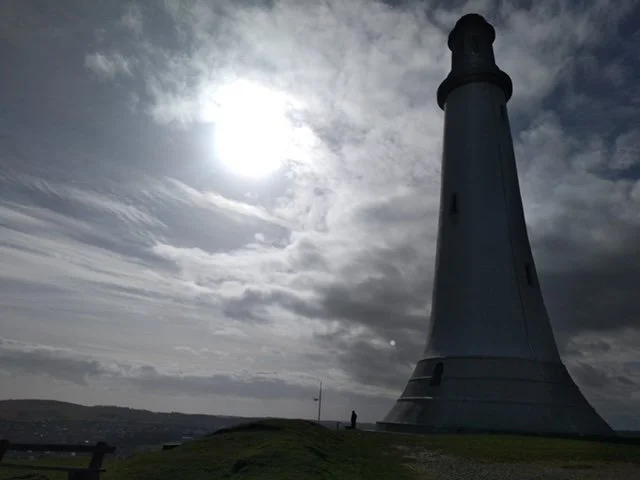
Photo by J. C. O’Neill. The Hoad: The John Barrow Monument, Ulverston, Cumbria.
References:
A History of Marchon Works at Whitehaven. Atkinson, G. Kennedy, J., Cumbria Industrial History Society. Page accessed 30/09/26
Gothic Literature; Chaplin S. 2011, York Press
The English Indices of Deprivation 2025 (Westmorland and Furness) Cumbria.gov.uk. Page accessed 30/09/26
The Hoad Monument page accessed 30/09/26
English Indices of Deprivation 2025; Ministry of Housing Communities and Local Government. Page accessed 30/09/26
Eight Jailed for County Lines Drug Plot BBC News. Page accessed 30/09/26
Director of Public Health Annual Report 2024 Westmorland and Furness Page accessed 29/09/26
National Life Tables: Life Expectancy in the UK 2022-2024 Page accessed 29/09/26
