Northern Gothic: The Furness Peninsula (A Tale of Two Mirrors and One Vampire)
Each year, I complete a pilgrimage to the county where I was born: Cumbria. My body and mind were formed and shaped by the small coastal town of Whitehaven, where my father was a GP. He deeply loved the community of stoical ex-miners, agricultural workers, and the men and women whose health was eroded by the vast chemical factory perched on the cliff above the town; vomiting gypsum and heavy metal contamination from the production of, amongst other things, phosphoric acid. (1)
I now approach my annual destination (the most beautiful valley in the world) via the Furness Peninsula; an austere stretch of land bordered by Morcambe Bay and the Irish Sea. The A590 is the single main road. It twists away from the M6 to skirt the Lake District National Park, passing through the genteel Georgian town of Ulverston to end its journey at the coastal industrial town of Barrow-in-Furness.
Within Gothic literature, a common figure is that of ‘the double’, the mirror image or ‘uncanny twin’ of the protagonist: two entities that appear identical on the surface but harbour opposing truths. This ‘Doppelgänger (walking double) can represent an ill omen, the conflicted identity of a protagonist, or can manifest the creature within. (2)
The towns of Ulverston and Barrow-in-Furness are such uncanny twins. Only ten miles apart, the populations seem precisely to mirror each other. According to the 2021 census (3), both places are predominantly white (96%) and both predominantly born within the UK (95%). 52% identify as Christian, 45% as having no religion, but here the resemblance ends. The mirror is shattered.
Ulverston is a market town nestling just below the idyllic Lakes. It has no areas of extreme deprivation,(3) it hosts international music festivals, health food stores and a college of costume design. Above the town stands a 100-foot tall monument to a nineteenth-century Secretary to the Admiralty; a vast lighthouse without any light. (4) The tower is an edifice that draws all eyes, yet views nothing; it is blind to the vast length of the Ulverston Canal, which once was the source of the town’s wealth. It does not need to witness; Ulverston remains mostly untroubled by decay.
Barrow-in-Furness has only one road in and out. Like a single, sclerosed artery, the A590 ends and begins in this distant coastal conurbation. Barrow represents the dark Id of Hyde compared to the urbane Ego of Ulverston’s Jekyll. Barrow is Cumbria’s most deprived urban centre, with almost 20% of its population trapped within England’s 10% most disadvantaged. Its Living Environment deprivation is worse, with the town ranking 9th of 300 local authorities. (5) Where Ulverston’s population works from home or within tourist and professional services, Barrow is dependent on the infrastructure of warfare, with BAE Systems providing employment building naval submarines. The cost of isolation, deprivation and industrialisation is high: county lines criminality and ‘deaths of despair’ cut deep lines in the features of this town. (6) (7).
The mirroring of these two places appears like a microcosm of the mirroring of the North and South of England: wealth and opportunity enjoyed by one, the other left to bear the post-industrial brunt of governmental neglect. The single artery of the A590 serves as a metaphor for the lifeblood that can be sucked from a vulnerable host., for the population of Barrow is shrinking, and life expectancy is well below the national average. (8)
I grew up in a small Northern coastal town, blighted by industrial processes considered necessary to maintain the wealth of the nation. The air of my town was polluted, and the seas corrupted, in ways that were tolerated only because the North is often unseen and unconsidered. Like a hungry, vampiric force, neoliberalism has enabled the draining of wealth and life and the emptying of communities. Yet the lives, wants, and needs of those in the North mirror those of any human being. We are not Doppelgängers or uncanny twins. We are you.
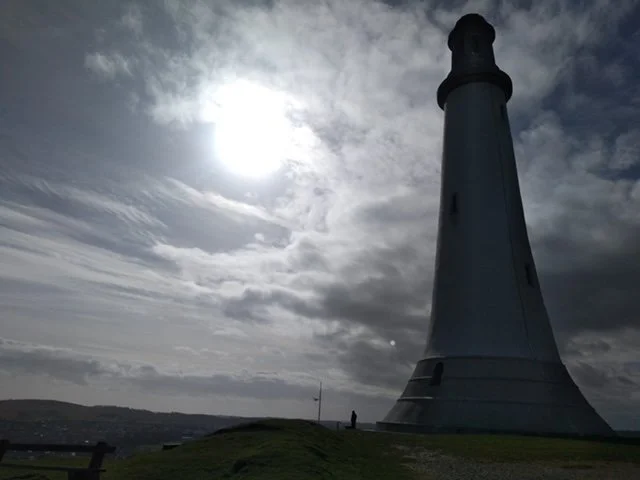
Photo by J. C. O’Neill. The Hoad: The John Barrow Monument, Ulverston, Cumbria.
References:
A History of Marchon Works at Whitehaven. Atkinson, G. Kennedy, J., Cumbria Industrial History Society. Page accessed 30/09/26
Gothic Literature; Chaplin S. 2011, York Press
The English Indices of Deprivation 2025 (Westmorland and Furness) Cumbria.gov.uk. Page accessed 30/09/26
The Hoad Monument page accessed 30/09/26
English Indices of Deprivation 2025; Ministry of Housing Communities and Local Government. Page accessed 30/09/26
Eight Jailed for County Lines Drug Plot BBC News. Page accessed 30/09/26
Director of Public Health Annual Report 2024 Westmorland and Furness Page accessed 29/09/26
National Life Tables: Life Expectancy in the UK 2022-2024 Page accessed 29/09/26

Northern Gothic: Chesterfield
Northern Gothic: the melancholy of the past tempered by the beauty and resilience of the present. (J. C. O’Neill, author.)
To me, for something to be ‘Gothic,’ it requires the presence of three essential components:
1. An awe-inducing structure or element.
2. An oppressive force.
3. The intrusion of the Past upon the Present. (6)
I recently visited Chesterfield in Derbyshire in order to review a newly opened bookshop specialising in Fantasy, and as part of my continuing mission to find the best scone in the North of England. In researching Chesterfield, I was struck by the ongoing devastating effects that the Miners’ Strike of 1984-5 had wrought upon the area. (2) As someone who was born in the North, the physical, political and spiritual battle between the Conservative government of Margaret Thatcher, and the Miners’ Unions remains a significant part of my formative years, and continues to echo daily in my life in Sheffield, South Yorkshire. (5)
I came to realise that Chesterfield itself is indeed Gothic. By this, I do not mean the famous twisted spire, the medieval market or the tiny, narrow Shambles area. I refer to the hidden spine and jutting ribs of coal that still lie silent beneath the Derbyshire soil; ink-black lines of compressed carbon that once gave life and work and meaning to so many. (4) This vast, ancient geology is the awe-inducing element.
The oppressive force is the formidable Margaret Thatcher, who came into power as prime minister of the United Kingdom in 1979, determined not just to control, but utterly subdue the power of Britain’s Trade Unions. Thatcher was an ardent neo-liberal, convinced that free trade, privatisation and consumer choice would lead to greater wealth and well-being for the nation. (1) She believed organisations that promoted the improvement of conditions and wages for working people were ‘the enemy within’. (7) And so, in 1984, a year-long struggle of epic proportions commenced; a war between two forces diametrically opposed in politics, but precisely aligned in passion for their cause, conviction of their beliefs, and implacable hatred for the other.
Thatcher won.
Within ten years, the number of people employed in the UK mining industry plummeted from approximately 220,000 to a mere 7,000. (2)
So, what of the third element required for inclusion in ‘the Gothic’: the intrusion of the past upon the present? Sheffield Hallam University has undertaken extensive research into the ongoing negative effects caused by the dismantling of the British Coal Industry. They have concluded that there remains a vast population of over five million people whose physical, mental and economic well-being have been negatively affected by the abrupt destruction of communities, workplaces and relationships. (2)
Some might say that events from 1984 have little relevance to today; however, here is the Gothic rub. Thatcher’s victory in 1985 led directly to the privatisation of other utilities: Gas, Electricity… Water. If you wonder why human excrement, animal waste and industrial by-products are to be found in our waterways, rivers, seas and canals – remember the Miners’ Strike of 1984/5. If what should be pure is foul, if what should be crystal-clear is murkily opaque, then this is the Past intruding upon the Present. (3)
Chesterfield: Northern Gothic.
REFERENCES
1. Encyclopaedia Britannica (2026). ‘Margaret Thatcher, prime minister of United Kingdom.’ https://www.britannica.com/biography/Margaret-Thatcher (accessed 28/08/26)
2. Fothergill S. Gore T. Leather D. (2024) ‘The State of the Coalfields 2024: Economic and social conditions in the former coalfields of England, Scotland and Wales.’ Sheffield Hallam University. https://www.shu.ac.uk/centre-regional-economic-social-research/publications/state-of-the-coalfields-2024 (accessed 28/08/26)
3. Marine Conservation Society 2026. ‘Sewage and Monitoring.’ https://www.mcsuk.org/what-we-do/pollution/sewage-pollution/ (accessed 28/08/26)
4. Northern Mine Research Society (Updated 11/05/26) https://nmrs.org.uk/mines-map/coal-mining-in-the-british-isles/derbynotts/derby/ (accessed 28/08/26)
5. Sheffield City Council. Sheffield Libraries Archives and Information 2009-2023. ‘Sources for the study of The Miners’ Strike 1984 – 1985’ https://www.sheffield.gov.uk/sites/default/files/2023-11/Sources%20for%20researching%20the%20history%20of%20the%20Miners%20Strike.pdf (accessed 28/08/26)
6. Stevens, D. (2000) The Gothic Tradition (Cambridge Contexts in Literature). Cambridge: Cambridge University Press
7. Thatcher, M. (1984) The Margaret Thatcher Foundation. Speech to 1922 Committee 19/07/84 (the enemy within) https://www.margaretthatcher.org/document/105563 (accessed 18/08/26)
Northern Gothic: the melancholy of the past tempered by the beauty and resilience of the present.
(J. C. O’Neill, author.)
To me, for something to be ‘Gothic,’ it requires the presence of three essential components:
1. An awe-inducing structure or element.
2. An oppressive force.
3. The intrusion of the Past upon the Present. (6)
I recently visited Chesterfield in Derbyshire in order to review a newly opened bookshop specialising in Fantasy, and as part of my continuing mission to find the best scone in the North of England. In researching Chesterfield, I was struck by the ongoing devastating effects that the Miners’ Strike of 1984-5 had wrought upon the area. (2) As someone who was born in the North, the physical, political and spiritual battle between the Conservative government of Margaret Thatcher, and the Miners’ Unions remains a significant part of my formative years, and continues to echo daily in my life in Sheffield, South Yorkshire. (5)
I came to realise that Chesterfield itself is indeed Gothic. By this, I do not mean the famous twisted spire, the medieval market or the tiny, narrow Shambles area. I refer to the hidden spine and jutting ribs of coal that still lie silent beneath the Derbyshire soil; ink-black lines of compressed carbon that once gave life and work and meaning to so many. (4) This vast, ancient geology is the awe-inducing element.
The oppressive force is the formidable Margaret Thatcher, who came into power as prime minister of the United Kingdom in 1979, determined not just to control, but utterly subdue the power of Britain’s Trade Unions. Thatcher was an ardent neo-liberal, convinced that free trade, privatisation and consumer choice would lead to greater wealth and well-being for the nation. (1) She believed organisations that promoted the improvement of conditions and wages for working people were ‘the enemy within’. (7) And so, in 1984, a year-long struggle of epic proportions commenced; a war between two forces diametrically opposed in politics, but precisely aligned in passion for their cause, conviction of their beliefs, and implacable hatred for the other.
Thatcher won.
Within ten years, the number of people employed in the UK mining industry plummeted from approximately 220,000 to a mere 7,000. (2) So, what of the third element required for inclusion in ‘the Gothic’: the intrusion of the past upon the present? Sheffield Hallam University has undertaken extensive research into the ongoing negative effects caused by the dismantling of the British Coal Industry. They have concluded that there remains a vast population of over five million people whose physical, mental and economic well-being have been negatively affected by the abrupt destruction of communities, workplaces and relationships. (2)
Some might say that events from 1984 have little relevance to today; however, here is the Gothic rub. Thatcher’s victory in 1985 led directly to the privatisation of other utilities: Gas, Electricity… Water. If you wonder why human excrement, animal waste and industrial by-products are to be found in our waterways, rivers, seas and canals – remember the Miners’ Strike of 1984/5. If what should be pure is foul, if what should be crystal-clear is murkily opaque, then this is the Past intruding upon the Present. (3)
Chesterfield: Northern Gothic.
REFERENCES
Encyclopaedia Britannica (2026). ‘Margaret Thatcher, prime minister of United Kingdom.’ https://www.britannica.com/biography/Margaret-Thatcher (accessed 28/08/26)2.
Fothergill S. Gore T. Leather D. (2024) ‘The State of the Coalfields 2024: Economic and social conditions in the former coalfields of England, Scotland and Wales.’ Sheffield Hallam University. https://www.shu.ac.uk/centre-regional-economic-social-research/publications/state-of-the-coalfields-2024 (accessed 28/08/26)3.
Marine Conservation Society 2026. ‘Sewage and Monitoring.’ https://www.mcsuk.org/what-we-do/pollution/sewage-pollution/ (accessed 28/08/26)4.
Northern Mine Research Society (Updated 11/05/26) https://nmrs.org.uk/mines-map/coal-mining-in-the-british-isles/derbynotts/derby/ (accessed 28/08/26)5.
Sheffield City Council. Sheffield Libraries Archives and Information 2009-2023. ‘Sources for the study of The Miners’ Strike 1984 – 1985’ https://www.sheffield.gov.uk/sites/default/files/2023-11/Sources%20for%20researching%20the%20history%20of%20the%20Miners%20Strike.pdf (accessed 28/08/26)6.
Stevens, D. (2000) The Gothic Tradition (Cambridge Contexts in Literature). Cambridge: Cambridge University Press 7.
Thatcher, M. (1984) The Margaret Thatcher Foundation. Speech to 1922 Committee 19/07/84 (the enemy within) https://www.margaretthatcher.org/document/105563 (accessed 18/08/26)